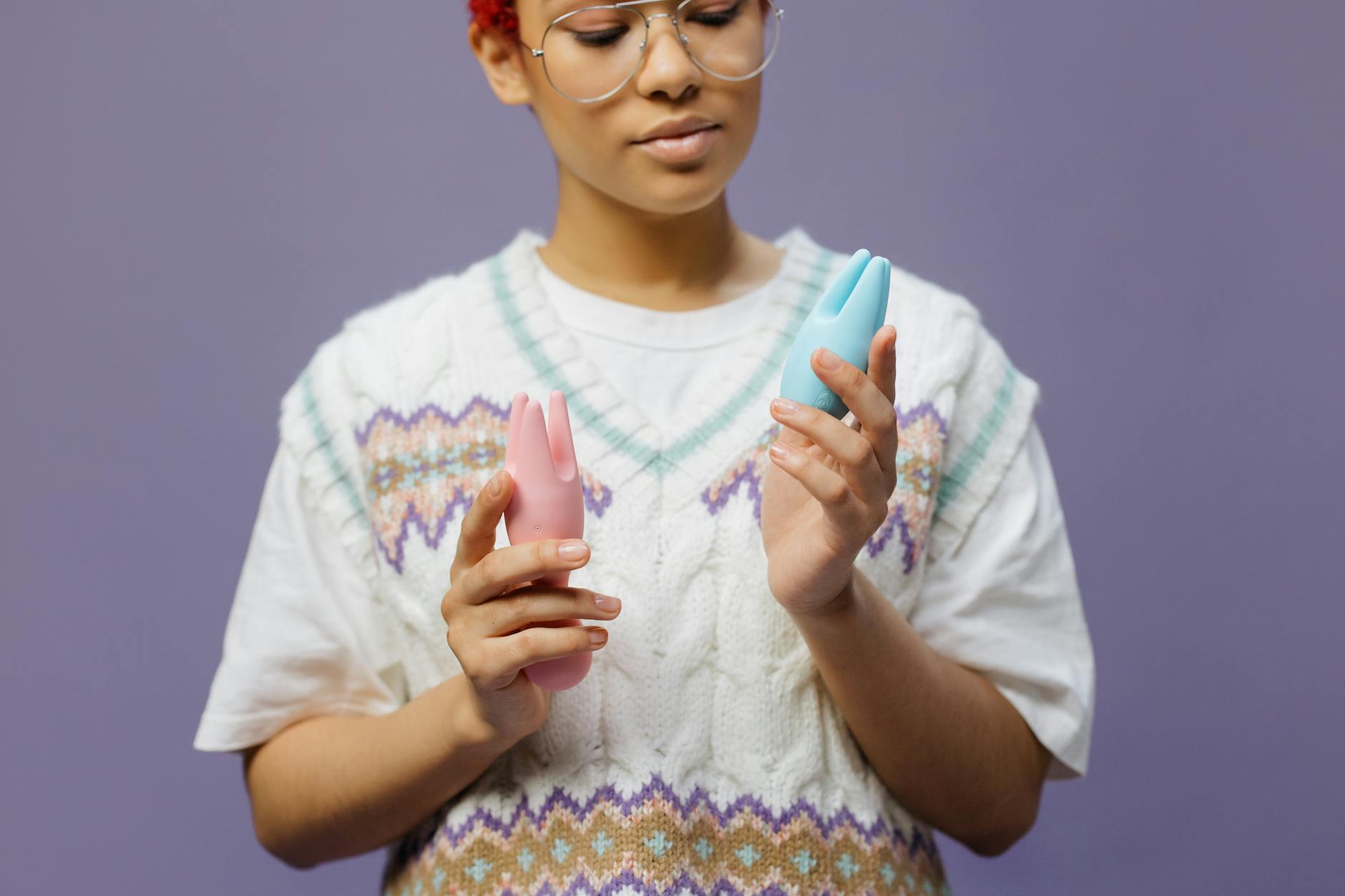
Here's the awkward truth nobody mentions
You find your rhythm, the sensation is building, and then your hand cramps. Your wrist starts to ache. Your arm gets tired. You're three minutes away from something really good, but your body is tapping out first. It's frustrating and it kills the entire momentum.
Then people assume the problem is the lemon vibrator itself, or their body, or something wrong with how they're doing it. Usually, it's none of those things. It's a positioning and pacing issue that's completely fixable.
Why hand fatigue happens with any clitoral vibrator
Your arms aren't built for sustained, precise movements. When you're holding a lemon clitoral vibrator against your body, you're essentially doing an isometric hold. Your muscles are contracting without moving, which fatigues them faster than dynamic movement would.
Add in the fact that you're probably tense. Pleasure builds tension. Your shoulders rise, your hand grips tighter, your forearm locks. That's when five minutes feels like forever.
The positioning of your hand matters wildly. If you're reaching awkwardly, or holding the device at an angle that's not aligned with your arm's natural geometry, every second burns more muscle energy. And if you're changing positions every time you shift, you're resetting that fatigue clock constantly.
The three positions that change everything
Position One: The Supported Cradle
Lie on your back with a pillow under your hips and another under your upper back. Instead of holding the lem vibrator in your hand, rest your hand and wrist on your lower belly, letting the device do the work from a stable, low-effort position. Your arm isn't doing the work. Gravity and your body position are. This is the longest-duration position for most people because there's zero strain.
Your hand is just guiding, not gripping. Your wrist stays neutral. Your shoulder is relaxed. You can stay here for 30 minutes without fatigue.
Position Two: The Supported Side Lie
Lie on your side with your top leg bent and a pillow between your knees. Rest the hand holding your lemon vibrator on the pillow between your legs. The pillow bears half the weight. Your hand is stable and supported. Your arm isn't extended or reaching. Your neck and shoulder stay relaxed because you're not twisted.
This position is especially good if you like a particular angle that the Supported Cradle doesn't give you. You get the angle adjustment without the fatigue.
Position Three: The Seated Recline
Sit with your back against the headboard or a wall, knees bent, feet flat on the bed. Rest your working arm on your thigh or on a pillow placed across your lap. The pillow or thigh is doing the support work. Your hand is just making micro-adjustments. You can see what's happening, which helps mentally, and the position is neutral for your neck and shoulders.
This works well if you like to take breaks, shift position, or if you want to be more present and aware during extended sessions.
The pattern: in every position, something else is bearing the weight. Your hand is just the guide.
Pacing tricks that let you go longer
Intensity and duration are inversely related. If you're running your lemon clitoral vibrator at pattern seven or eight, you'll come faster but fatigue sets in sooner. If you start at pattern three or four, you can go for twenty minutes building gradually without burning out your hand.
Try this rhythm: spend the first five to ten minutes at a lower intensity, exploring different patterns and positions. Let your body wake up. Then, once you're really aroused, shift to higher intensity for the final phase. Your hand is fresher because you haven't been white-knuckling it the whole time, and the buildup makes the final intensity feel even more intense.
Take breaks. Seriously. Stop for thirty seconds, shake out your hand, reset your position, then continue. You're not losing momentum. You're resetting your muscle fatigue so you can go longer. Your nervous system doesn't care if those thirty seconds happen. Your hand does.
Alternate between patterns even if one feels amazing. Your hand adapts to repetitive motion, which actually dulls sensation slightly over time. Switching patterns every three to five minutes keeps sensation fresh and gives your muscle memory a break.
Photo by Ron Lach on Pexels
Grip and hand technique
You don't need to grip hard. The lem vibrator isn't going anywhere. A soft, open-palm grip uses maybe ten percent of the muscle tension that a tight grip does. Your hand should feel relaxed, almost like you're barely holding it.
Keep your wrist straight. Don't bend it at an angle to reach. Adjust your body position instead. A bent wrist fatigues fastest because you're fighting gravity and muscle tension at the same time. A straight wrist is a neutral wrist, and neutral is what lasts.
Your fingers should do minimal work. Let your palm and the base of your hand do the stabilizing. Fingers are for fine adjustments, not for bearing weight. If you notice your fingers gripping hard, that's a sign to reposition so your wrist and palm are handling more of the load.
When fatigue means something else
If your hand fatigues within one or two minutes, or if you feel sharp pain (not muscle tiredness, but actual pain), something else might be going on. Nerve compression, repetitive strain injury, or arthritis can all make extended sessions feel impossible.
In those cases, the answer might be a hands-free option like positioning yourself against a pillow or surface, or exploring different toy shapes that distribute pressure differently. A wider grip diameter, for instance, uses different muscles and might be more comfortable. If you have arthritis or chronic hand pain, this is genuinely worth discussing with a physical therapist.
For most people though, fatigue is just a positioning problem disguised as a limitation.
Building stamina without forcing it
Your hand's endurance will increase gradually if you're using your lemon vibrator regularly. The muscles involved get stronger, your nervous system gets more efficient, and what felt like a long time after two weeks starts to feel short after a month.
Don't train by pushing through pain. That's backwards. Train by using good positioning from the start, pacing yourself, and taking breaks. You build endurance by making extended sessions feel easy, not by gutting them out.
Your body will tell you when it's ready for longer. Listen to that signal instead of overriding it.
The mental part matters too
Half of extended pleasure is mental stamina, not physical. If you're in your head worrying about whether your hand is tired, whether you're doing it right, whether you're taking too long, you're pulling focus away from sensation. That actually makes it harder to reach orgasm, which ironically makes the session longer.
Set a time boundary if it helps. "I have thirty minutes and I'm not checking the clock." Then forget about time. Focus on sensation, on breathing, on what feels good in this exact moment. When you're present like that, hand fatigue becomes background noise instead of the main event.
Extended pleasure isn't about pushing your body to its limit. It's about creating conditions where your body can relax into what it's experiencing.
The setup that works best
Before you start, get comfortable. Adjust lighting, temperature, water nearby if you want it. Put your phone somewhere you can't see it. Use pillows strategically so you're not propped on your elbows or straining your neck. If you're with a partner, they can help adjust pillows or be present in whatever way feels good.
Start slow. Warm up your body. Let arousal build naturally. Only then shift to higher intensity if you want it. A thirty-minute session where you spend twenty minutes building and ten minutes at peak intensity feels way more sustainable than ten minutes of hard intensity from the start.
If you're using a lemon vibrator like the Lem for the first time with this approach, start with fifteen minutes and see how your hand feels. Build from there. Your nervous system and your muscles will adapt.
Troubleshooting extended sessions
My wrist still hurts even with good positioning. Try rotating your wrist every few minutes, even slightly. Micro-movements prevent stagnation. Also check that your device is held at a forty-five-degree angle, not perpendicular. Angles matter for wrist strain.
I lose sensation after a while. You're either getting tired or your nervous system is adapting to sustained stimulation. Take a two-minute break, shake out your hand, breathe deeply. Restart at a lower intensity and build again. Fresh starts reset sensation.
My forearm cramps even when my hand feels fine. Your forearm is doing too much work. You're probably flexing muscles that don't need to be flexed. Practice the Supported Cradle position where your arm is just resting, not actively holding.
I keep changing positions and it breaks my focus. Choose one position and commit to it for a full session. Once you find your best position, stick with it for a month. You'll be amazed at how much longer you can go when you're not constantly resetting.
FAQ: Extended sessions and hand fatigue
How long is too long for a pleasure session with a lemon clitoral vibrator?
There's no such thing as too long if you're comfortable and enjoying it. People have sessions that last ten minutes, an hour, or anywhere in between. The goal isn't duration. It's comfort and presence. If you're enjoying forty-five minutes and your hand feels fine, that's perfect. If you're enjoying ten minutes and your hand is tired, that's also perfect. Listen to your body, not a clock.
Can I use my lemon vibrator hands-free?
Yes. Positioning yourself against a pillow, wedge, or surface means you can control pressure and movement with your hips and core instead of your hand. This requires some experimentation to find the right angle and pressure, but it's a game-changer for people with hand fatigue or who want to be hands-free sometimes.
Why do my hands get tense when I'm aroused?
Tension is part of the arousal response. Your muscles naturally engage as you get more aroused. The trick is to consciously relax your non-working muscles while allowing the arousal to build. Tense your core, pelvic floor, and legs if it feels good. But keep your shoulders, neck, and the hand holding your lem vibrator as relaxed as possible. This is a skill that improves with practice.
Does grip strength matter for using a lemon vibrator comfortably?
Not much. A firm grip is actually worse for endurance because it fatigues faster. A soft, open grip with most of the stabilization happening in your palm and forearm is best. If you have weak grip strength, this is actually an advantage because you'll naturally use less force.
Can I switch hands partway through?
Absolutely. If your right hand is tired, switch to your left. You might lose a bit of familiarity with the angle, but your hands will both get a break. Some people alternate hands every ten minutes in longer sessions specifically to build endurance in both sides.
What if I want extended sessions but I'm recovering from pelvic floor dysfunction?
Check out our guide on how to use a lemon vibrator when recovering from pelvic floor dysfunction for specifics. The short version: longer sessions are fine as long as intensity is low and your pelvic floor stays relaxed. This actually builds awareness and control over time.
Is there a lemon vibrator that's easier to hold for long periods?
The Lem is ergonomically designed with a handle that fits most hand sizes and sits naturally in your palm. Its shape distributes weight across your hand instead of concentrating it in your fingers. That said, what's comfortable is individual. The best vibrator is the one that feels good in your hand and doesn't cause strain.
How do I know if I'm using a lemon vibrator wrong if my hand gets tired fast?
You're likely gripping too hard, holding at an awkward angle, or using too-high intensity right from the start. None of those are "wrong," but they're unsustainable. Try the Supported Cradle position, soften your grip, start at a lower pattern, and see what shifts. Usually one of those four changes makes a huge difference.
The real thing about extended pleasure
Longer doesn't automatically feel better. Sometimes a focused ten-minute session where you're completely present is way more satisfying than thirty minutes where you're half-distracted. The goal isn't to exhaust yourself. It's to have as much time and comfort as you want, whenever you want it.
Once hand fatigue is off the table, you get to choose. You might pick quick sessions some days and longer ones others. You might discover you prefer building slowly over an hour to intense and fast. You might find that pacing and presence matter more than duration. All of that becomes possible when your hand isn't the limiting factor.
If you're looking to explore extended sessions more deeply, or if you want guidance on how pleasure builds over time in relationships, consider reaching out to discuss your specific situation.
Sources and References
- American Physical Therapy Association. Ergonomics and repetitive strain injury prevention guidelines.
- Cleveland Clinic. Muscle fatigue and isometric exercise physiology.
- Mayo Clinic. Hand and wrist strain prevention in daily activities.
- National Institute of Neurological Disorders and Stroke. Nerve compression and repetitive motion injuries.